10 Emerging Technologies That Could Transform the Next Decade
Technology Tech
Introduction
Technology is evolving faster than ever, reshaping industries, economies, and the way people live and work. Innovations that once seemed futuristic are becoming reality, creating new opportunities while disrupting traditional business models. As organizations invest heavily in research and development, several emerging technologies are poised to define the next decade and influence everything from healthcare and finance to transportation and communication.
Key Concepts and Overview
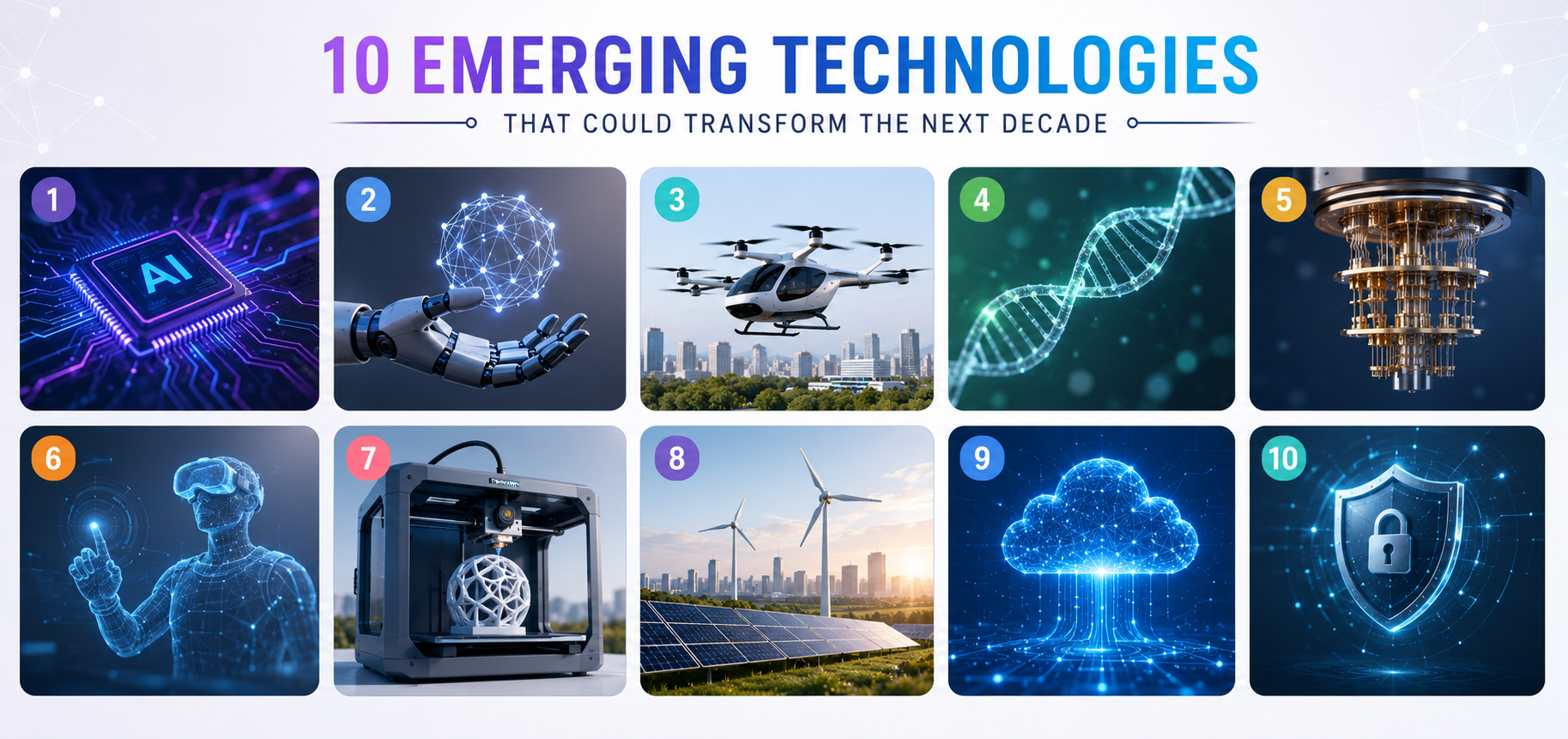
1. Artificial Intelligence (AI)
AI continues to advance rapidly, powering automation, predictive analytics, and intelligent decision-making across industries.
2. Quantum Computing
Quantum computers have the potential to solve complex problems that traditional computers cannot efficiently process, particularly in science, logistics, and cybersecurity.
3. Extended Reality (XR)
Combining virtual reality, augmented reality, and mixed reality, XR is transforming education, entertainment, and workplace collaboration.
4. 6G Connectivity
Although 5G deployment is still expanding, research into 6G promises faster speeds, lower latency, and enhanced connectivity.
5. Autonomous Vehicles
Self-driving technology continues to improve, with applications extending beyond personal transportation to logistics and delivery services.
6. Edge Computing
Processing data closer to where it is generated reduces latency and improves real-time performance for connected devices.
7. Biotechnology and Gene Editing
Advanced genetic technologies are opening new possibilities for personalized medicine and disease prevention.
8. Green Energy Technology
Innovations in battery storage, solar energy, and sustainable infrastructure are accelerating the transition to cleaner energy sources.
9. Blockchain Applications
Beyond cryptocurrency, blockchain is being used for supply chain transparency, digital identity management, and secure transactions.
10. Advanced Robotics
Modern robots are becoming smarter, more adaptive, and increasingly capable of assisting humans in manufacturing, healthcare, and service industries.
Benefits and Real-World Applications
These technologies offer significant benefits, including improved efficiency, reduced operational costs, enhanced healthcare outcomes, and sustainable economic growth. Businesses can leverage AI and automation to streamline operations, while advancements in connectivity and edge computing enable smarter cities and IoT ecosystems.
Consumers also benefit from personalized services, improved transportation systems, and more accessible digital experiences.
Challenges and Considerations
Despite their potential, emerging technologies face challenges such as regulatory uncertainty, cybersecurity risks, ethical concerns, and high implementation costs. Workforce adaptation is another critical factor, as employees will need new skills to thrive in increasingly technology-driven environments.
Organizations must balance innovation with responsible deployment and data protection practices.
Future Trends and Innovations
The coming decade will likely see deeper integration between AI, robotics, cloud computing, and next-generation networks. Technologies will become more interconnected, enabling autonomous systems, intelligent infrastructure, and highly personalized digital experiences.
Businesses that embrace innovation early may gain significant competitive advantages as these technologies mature and become mainstream.
Conclusion
The next decade promises remarkable technological transformation. From artificial intelligence and quantum computing to biotechnology and advanced robotics, these emerging innovations have the potential to reshape industries and daily life. Understanding these trends today can help individuals and organizations prepare for a future driven by innovation, connectivity, and intelligent automation.
Search
Categories
Recent News
- 15 Common Technology Myths That Need to Die
- The Fascinating Evolution of AI: From Rule-Based Systems to Intelligent Agents
- The Environmental Impact of Modern Technology
- The Best Tech Skills to Learn for the Next 10 Years
- How to Speed Up a Slow Laptop Without Buying New Hardware
- Cloud Storage Explained: Everything You Need to Know
- Top 10 Browser Extensions That Will Instantly Make You More Productive
- 10 Emerging Technologies That Could Transform the Next Decade
Popular News
- The Modern Football Fans Secret Weapon
- 10 Common Online Habits That Put Your Personal Data at Risk
- 7 Shocking Ways Your Online Activity Is Being Tracked Right Now (And What You Can Do About It)
- 10 AI Tools That Can Save You 10+ Hours Every Week
- 10 Emerging Technologies That Could Transform the Next Decade